
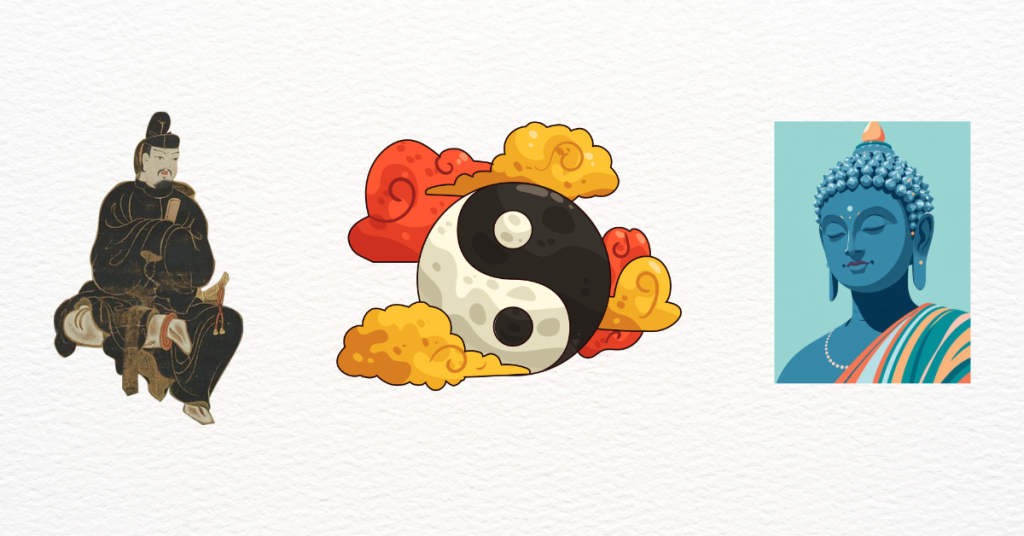
On February 22nd, Member Prescott Bergh shared this information during his presentation on Forgiveness and Resilience in Vietnam.
Confucianism is a system of thought and behavior variously described as a tradition, philosophy, religion, theory of government, or way of life. Confucianism integrates philosophy, ethics, and social governance, with a core focus on virtue, social harmony, and familial responsibility.
Confucianism emphasizes virtue through self-cultivation and communal effort. Key virtues include benevolence, righteousness, propriety, wisdom, and sincerity. These values, deeply tied to the notion of Heaven, present a worldview where human relationships and social order are manifestations of sacred moral principles. While Confucianism does not emphasize an omnipotent deity, it upholds Heaven as a transcendent moral order.
Taoism is a philosophical and religious tradition emphasizing harmony with the Tao. Translations of Tao include ‘way’, ‘road’, or ‘path’, generally understood in the Taoist sense as an enigmatic process of transforming ultimately underlying reality. Taoist practices, including forms of meditation, astrology, qigong, and feng shui. Taoist practice is self-cultivation and a more harmonious existence. Taoist ethics generally emphasize virtues of effortless action, naturalness, simplicity, and the three treasures of compassion, frugality, and humility. Taoism has long been closely intertwined with Chinese folk religion, and the boundary between them is often fluid in practice.
Buddhism views life as a continuous cycle of rebirth where beings are reborn based on their karma (actions). The ultimate goal is to stop this cycle by eliminating craving and achieving Nirvana, which is a state of liberation from suffering. Buddhism is often viewed as a philosophy or way of life, focusing on understanding the mind and reality rather than worshipping a creator god.
Key Practices and Ethics
• The Eightfold Path: A guide for ethical living, including Right View, Resolve, Speech, Action, Livelihood, Effort, Mindfulness, and Concentration.
• Ethical Principles: Followers typically avoid stealing, killing, lying, sexual misconduct, and intoxicants.
• Meditation: Central to training the mind, gaining insight, and developing wisdom and compassion.
• Daily Life: Focuses on mindfulness, compassion, and avoiding extremes of self-indulgence and self-denial.